On Blurbing
Or, Back of Book Business

When I was a magazine journalism major at the esteemed Missouri School of Journalism, our professors used to emphasize that a substantial portion of magazine readers flip to the back of their magazines first to see what their favorite publication had to offer at the end of the edition. While we learned that front cover photography, headlines, and design details mattered, the lesson about readers flipping to ‘back of book’ was a reminder to not run out of steam at the end of a magazine.
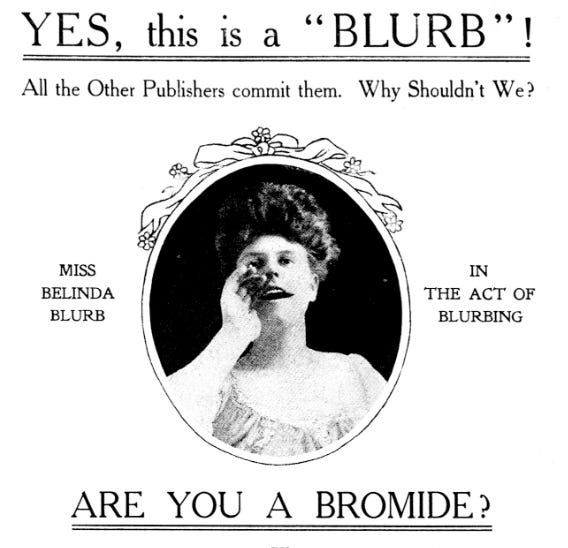
The first instance of the word blurb, according to Wikipedia.
One of the reasons why I loved my magazine journalism classes so much was that we were challenged to make something cohesive out of disparate pieces and departments. Back then, the gold standard was set by the September issue of Vogue, Sports Illustrated’s investigative reports. We also scrutinized the short-lived startups like George Magazine and Nerve. I loved reading magazines because embedded in the act of reading an entire issue was a little detective mystery of discerning how exactly all these elements fit. Now, as a writer and historian, ‘back of book’ means something entirely different: blurbs.
Blurbs are the endorsements that you read on the back cover of a book, which ostensibly helps a potential reader make a commitment of time (and sometimes money) to a book. Readers may be surprised to learn that blurbs are usually collected by writers, as well as editors, on behalf of the book. The writer is sometimes asked to reach out to colleagues and friends directly, as well as provide a list of potential people to provide blurbs. I have always found this an awkward and uncomfortable practice, because I know how much time it takes to read an advanced copy of a book in order to provide a solid endorsement. Some blurbing readers skim a manuscript, choosing to read the introduction and the conclusion. Others, I’m sure they wouldn’t admit it, use ‘vibes’ to write a blurb. I’m a big believer that I have to read an entire book before I blurb it. I learned this lesson from a colleague who agreed to blurb a book once and then realized it was riddled with misinterpretations of her research area. Readers can report errors or issues with advanced copies, but there are no guarantees that your concerns will be addressed.
No matter how a blurb comes together, it can be a difficult process because as a writer you want to let readers know that other writers in your subject matter orbit find your book engaging, or smart, or worthwhile. The New York Times wrote an article a few months ago announcing Simon and Schuster’s decision to no longer have writers collect blurbs, and the piece questioned if blurbs matter at all. I don’t know if there is a definitive answer to how blurbs shape purchasing and reading decisions, but as a writer, I appreciate them and I try to fulfill most requests for them. But, it’s becoming more difficult to say yes. The joy in giving a blurb comes from know that you are cheering an author on as they approach a finish line. Pulitzer Prize winning biographer Ilyon Woo put it best on what receiving a blurb feels like: “When I was writing, I was in the deep, dark basement of my mind…and the blurbs were the first signs of life outside the book.”
With that being said, I’m happy to share an early blurb for my forthcoming book, HOW BRIGHT THE PATH GROWS: THE UNTOLD STORY OF THE WOMEN WHO MADE THE MARCH ON WASHINGTON, from writer Caleb Gayle. I’ve known Caleb since my days teaching at the University of Oklahoma, and he has been an incredible interpreter of the racial politics of the Southwest and West, with his two books, We Refuse to Forget and Black Moses and many articles. I’m grateful for his kind words.
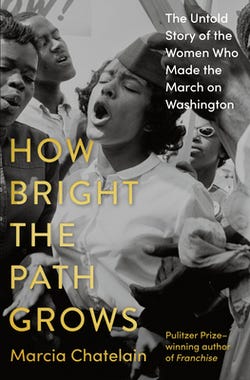
“Chatelain has done what I didn’t know was possible. She has rendered, with clarity and care, the lives of women who shaped the March on Washington but have been relegated to the margins of its memories. How Bright the Path Grows is more than a corrective. It is as much revelation as it is instruction. Chatelain teaches us how to tell fuller, truer stories. This is the model for recovering what we have been quick to forget.”—Caleb Gayle, author of Black Moses
Until Next Class,
Your Favorite Prof